
LEANING TOWER OF PISA ARCHITECTURE
About Leaning Tower of Pisa
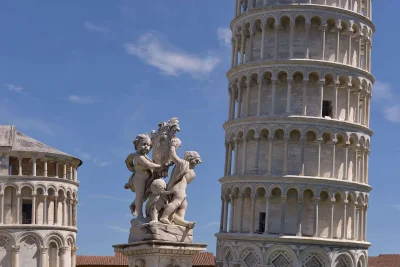
The Leaning Tower of Pisa (Torre Pendente di Pisa), located in the heart of Pisa’s Piazza del Duomo, is a remarkable example of Romanesque architecture and one of Italy’s most iconic landmarks. Built between the 12th and 14th centuries, it showcases the elegance of medieval design with rounded arches, marble columns, and intricate carvings. Originally intended as the freestanding bell tower for Pisa’s cathedral, it was constructed using white marble and limestone, which gives it a bright, graceful appearance.
What makes it truly unique, however, is its famous tilt, the result of a shallow foundation and soft ground beneath. This combination of artistic beauty and structural imperfection has turned the Leaning Tower of Pisa into a global symbol of architectural wonder and resilience.

A masterpiece of medieval design
The Leaning Tower of Pisa is built in the Romanesque style, known for its rounded arches, marble details, and balanced design. Construction of the tower began in the 12th century and continued into the 14th century. It is part of Pisa’s grand Piazza del Duomo complex, alongside the Cathedral of Santa Maria Assunta, the Baptistery, and the Camposanto. All share the same white marble and elegant arcades that define the Pisan Romanesque style. The tower’s circular base, arches, and columns were designed to match the cathedral’s harmony and beauty. The tower reflects the artistic ambition of the medieval city of Pisa at the height of its power. Every part of the design was created to impress, from its circular base to the rhythmic arches and columns spiraling toward the sky.

The architects behind the Tower
The identity of the tower’s architect is still uncertain. For many years, the design was credited to Guglielmo and Bonanno Pisano, a 12th-century artist from Pisa. However, a 2001 study suggests that the original architect may have been Diotisalvi, based on similarities between the tower and his other buildings in Pisa, such as the San Nicola Bell Tower and the Baptistery. Giovanni di Simone came later, in the 13th century, when construction resumed after decades of pause. He continued the work after the tower had already begun to lean. To compensate for the tilt, he made the upper floors slightly taller on one side, creating the tower’s distinctive curved shape.

A perfect circle of stone and symmetry
The tower was built mainly from white marble and limestone, the same materials used for the nearby cathedral and baptistery. This gave the entire Piazza dei Miracoli a unified, polished look. Inside, the walls are made of stone and lime mortar, while the spiral staircase features thick marble steps. The tower’s eight levels and 207 columns were designed to create harmony, even as the lean developed. Despite the unstable foundation, the craftsmanship remains surprisingly precise.
Materials and craftsmanship
The tower was built using white and grey marble from nearby quarries in San Giuliano and limestone from the Pisan Hills. Builders shaped and polished each block by hand, using simple tools but remarkable precision. The alternating light and dark tones of the marble not only enhance its beauty but also reduce heat absorption, helping to preserve the stone over time.

How did the tilt happen?
The Leaning Tower of Pisa began to tilt soon after construction began in 1173, not because of a mistake, but due to the soft, unstable ground beneath it, made of clay, sand, and shells. Its shallow foundation, only about three meters deep, couldn’t support the heavy marble and limestone structure, so as more floors were added, one side began to sink and the tower leaned south. Over time, the tilt increased as the soil shifted due to rain, groundwater, and the passage of time. Luckily, long construction pauses allowed the ground to settle, preventing collapse. The project took nearly 200 years to complete, involving several architects and builders. None of them was blamed, as people viewed the tilt as a challenge to overcome rather than a failure. Later builders tried to correct the lean instead of starting over, and what began as a mistake eventually became the tower’s most famous feature. If you want to see this engineering marvel in person, be sure to check out our complete guide on how to visit Pisa, Italy for essential travel tips and ticket information.

The Tower’s unique proportions
The Leaning Tower of Pisa stands approximately 56 meters tall, divided into eight levels: the ground floor, six open galleries, and the bell chamber. Each gallery is supported by 30 columns, totaling 207 marble columns.
The tower has a diameter of 15.5 meters and a spiral staircase with 294 steps leading to the top. Its slim, elegant form was designed for balance, and it would have stood perfectly straight if the soft soil beneath had not given way. Even today, the tower’s symmetry and slight tilt create a graceful sense of movement.
Ready to explore the Leaning Tower of Pisa?

Skip-the-line
Leaning Tower of Pisa and Cathedral Ticket
See 'architecture gone wrong' with our Leaning Tower of Pisa and Cathedral ticket! Enter the famous Leaning Tower immediately with skip-the-line tickets, and avoid long lines. Then climb to the top for stunning panoramic views over Pisa and a close-up look at its seven bells. You can also visit the Pisa Cathedral - a huge, beautiful building made out of white marble! A digital audio guide is also available in our app, so you can learn about everything you’re seeing.

Best views of Pisa
Leaning Tower of Pisa Tour
Join a small group tour of the Leaning Tower of Pisa. Skip the line and enter Miracle Square without waiting. Visit this UNESCO World Heritage Site and an over-800-year-old symbol of Pisa. Climb the Leaning Tower as your guide explains how it began to tilt and how it survived. Admire the tower’s seven historic bells at the top, and enjoy panoramic views of Pisa. Visit the Cathedral to admire its detailed mosaics, marble floors, and Gothic arches. Book your spot on the Leaning Tower of Pisa tour and experience Pisa’s most iconic landmark up close!

The details that define Pisa’s style
The Leaning Tower’s charm lies not only in its structure but also in its decoration. Each gallery features graceful arcades of marble columns that create a play of light and shadow throughout the day. Intricate carvings of animals, flowers, and religious motifs decorate the capitals and moldings. The use of alternating light and dark marble gives the exterior its distinctive striped pattern, a distinctive mark of Tuscan Romanesque design.

The bells that sing over Pisa
At the very top sits the bell chamber, completed in the 14th century. It holds seven bronze bells, each tuned to a musical note. The largest, L’Assunta, was cast in 1655 and weighs over three tons. The open arches of the chamber allow the sound to carry across Pisa, while visually, they complete the tower’s elegant design. Although silenced during restoration, all seven bells remain functional today. After the restoration and stabilization work were completed in 2001, the bells were tested and confirmed to be safe. However, regular ringing was stopped to prevent vibrations that could affect the tower’s stability.

How engineers protected the design
During the late 20th century, engineers worked to stabilize the tower without altering its historic appearance. In 1990, the tower was closed to the public due to safety concerns, as the tilt had reached a dangerous angle. Over the next decade, a team of international experts used a combination of lead counterweights, steel cables, and a precise soil extraction method to gradually reduce the lean by about 40 centimeters. The soil removal technique, tested successfully in 1998, proved to be the key to stabilizing the structure. By 2001, the tower was declared safe and reopened to visitors. Today, the Leaning Tower leans at a stable 4 degrees, with the top standing 3.9 meters (12 feet) off vertical, a perfect balance between flaw and perfection. It is continuously monitored to ensure its long-term safety and preservation.

Interesting architectural facts
Visitors often report feeling slightly dizzy or off-balance when climbing the Leaning Tower of Pisa because of its tilt. This is well documented in visitor reviews, official tourism descriptions, and engineering studies of the tower. Here’s why it happens. The tower leans at about 4 degrees, and the spiral staircase follows that same angle. As you climb, the floor beneath your feet tilts relative to gravity, so your inner ear and sense of balance constantly adjust. This causes a mild feeling of disorientation, similar to walking on a slope or on a ship that’s slightly tilted. The effect is real but completely safe, and it’s part of what makes the climb such a memorable experience.

Architecture that inspired the world
Modern engineers often study the Leaning Tower of Pisa to understand how ancient structures can withstand centuries of stress and strain. The tower’s flexibility, caused by its soft foundation, allows it to absorb vibrations instead of resisting them – a key reason it has survived earthquakes and the passage of time. Advanced sensors now monitor the tower’s movement daily, ensuring it remains stable while preserving its famous tilt. The Leaning Tower of Pisa has also had a profound influence on architects across Europe. Its combination of technical ambition and artistic elegance became a model for medieval bell towers.
Today, the tower is admired for its harmony of art and engineering, its balance, endurance, and timeless beauty. Recognized as a UNESCO World Heritage Site, the Leaning Tower of Pisa is one of Italy’s most visited tourist attractions and one of the most iconic landmarks in the world.
Looking for Pisa tours from other cities? We’ve got you covered!

Pick-up & drop-off
Rome to Pisa Day Trip
Take a full-day trip from Rome to Pisa and travel through the beautiful Italian countryside. See the famous Leaning Tower, Cathedral, and Baptistery in Pisa. Learn the story behind the tower’s unique tilt and enjoy free time to walk, explore, and take photos. This small-group tour brings you the best of central Italy in one unforgettable day. Book now for a day full of sights and stories!

Small group tour
Pisa Tour from Florence
Go on a day trip to Pisa from Florence and explore Pisa’s most famous landmarks in just a few hours. Go on a guided tour through Piazza dei Miracoli, a UNESCO World Heritage Site. See the 800-year-old Leaning Tower of Pisa standing 191 feet (58 meters) tall. Admire the 11th-century Pisa Cathedral and the Baptistery of St. John from outside, or opt to go inside. Round-trip transport by coach from Florence to Pisa is included. Book your spot on the Pisa Tour from Florence now and go directly into the heart of Pisa’s history!