
LEANING TOWER OF PISA HISTORY
Leaning Tower of Pisa: The true story behind the world’s famous tilted tower
History of the Pisa Leaning Tower
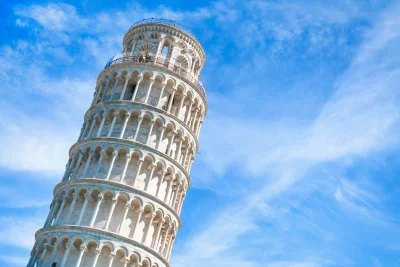
The Leaning Tower of Pisa is one of the world’s most recognizable landmarks and a proud symbol of Italy’s creativity and history. Construction began in 1173 as part of the city of Pisa’s grand cathedral complex, built to showcase the city’s growing power and influence. But soon after the first floors were completed, the soft, unstable soil beneath began to shift, and the tower started to lean. Despite wars, delays, and endless engineering challenges, work continued, and the tower was finally finished in the 14th century. Over the years, architects and engineers have worked carefully to stabilize it, saving it from collapse while keeping its characteristic lean of about 4 degrees.
The tower has survived earthquakes and centuries of weather, defying all odds. In the late 20th century, major restoration projects reduced the tilt and made it safe again for visitors. Since 1987, the Leaning Tower and the entire Piazza dei Miracoli have been part of a UNESCO World Heritage Site. Today, millions of people visit Pisa, Italy to climb the spiral staircase and experience stunning views of the Piazza dei Miracoli and beyond.

Pisa’s golden age and the birth of a landmark
Before the tower was built, Pisa was one of Italy’s strongest maritime republics, known for its trade and naval victories. During this period, Pisa competed with other powerful city-states, including Venice and Genoa. Building the cathedral complex was a way to show its power, wealth, and importance in the Mediterranean world.
The Leaning Tower was part of a grand project called the Piazza dei Miracoli (Square of Miracles), which includes the Cathedral, Baptistery, and Camposanto Monumentale. The complex was meant to display Pisa’s power and devotion, symbolizing both faith and prosperity. Standing 56 meters tall, the tower was designed to serve as the bell tower for the Cathedral of Santa Maria Assunta; yet its famous tilt turned it into something far more iconic.

Who built the Pisa Tower?
The true designer of the Leaning Tower of Pisa remains uncertain. Most historians credit Bonanno Pisano, a local architect and sculptor, but others suggest Diotisalvi, who designed the nearby Baptistery. Since the tower took more than two centuries to complete, several architects likely contributed, each attempting to correct the leaning structure in their own way. Architects of the time worked without modern tools or knowledge of soil mechanics, relying only on observation and experience.
When construction resumed in the 13th century, Giovanni di Simone took charge of the project. He tried to compensate for the existing tilt by building the upper floors slightly taller on one side, which gave the tower its gentle curve. Despite these efforts, the lean continued, but Giovanni di Simone’s work helped preserve the tower’s stability and shape, allowing it to become one of the most recognizable monuments in the world. As Pisa’s power declined in the late Middle Ages, construction was halted, and each new builder inherited both the tower’s problems and its growing legend.

A Tower that was never meant to lean
Construction began in August 1173, thanks to a donation made in 1172 that paid for the first foundation stones. After the second floor in 1178 was completed, the tower began to tilt. The foundation was being built on soft, unstable soil made of clay and sand. The foundation was just about 3 meters deep and rested on this weak ground instead of solid rock. The tower itself was built from heavy white marble and limestone, which caused the ground to sink even further as construction continued.

It took almost 200 years to complete
The tilt became noticeable early on, but construction continued despite the problem. Over the next two centuries, the work was repeatedly stopped and resumed due to wars, financial difficulties, and engineering challenges. These pauses actually helped the tower survive because the soil had time to settle and compact. The tower has survived at least four strong earthquakes since 1280. Ironically, the same soft ground that caused the tilt helped absorb the shocks. When building resumed in the 14th century, engineers tried to adjust the upper floors to compensate for the lean, unintentionally giving the tower its distinctive curved shape. The construction was finally completed in 1372, almost 200 years after it began.

The workers and their craft
The Leaning Tower of Pisa was built by local workers from Pisa and nearby towns. These included stonemasons, marble cutters, bricklayers, lime mixers, and general laborers. They used white marble from San Giuliano and limestone from local quarries, moving the heavy stones to the site with ox-drawn carts. The builders didn’t have modern machines, so they relied on simple tools like chisels, hammers, ropes, pulleys, and wooden cranes powered by people or animals. Skilled craftsmen carved the tower’s beautiful arches, columns, and decorations, while other workers mixed mortar and carried the stones to higher levels
The elegance of Romanesque design
The Leaning Tower of Pisa was constructed in the Romanesque style, featuring white marble arches and columns that showcase the beauty of medieval Italian design. It was built to hold seven bells, one for each note of the musical scale, and they still ring today. The tower has eight levels and 294 steps leading to the top. Its famous lean, now about 4 degrees, turned what started as a construction flaw into one of the most well-known landmarks in the world.
Visit the Leaning Tower of Pisa with our exclusive travel offers!

Best views of Pisa
Leaning Tower of Pisa Tour
Join a small group tour of the Leaning Tower of Pisa. Skip the line and enter Miracle Square without waiting. Visit this UNESCO World Heritage Site and an over-800-year-old symbol of Pisa. Climb the Leaning Tower as your guide explains how it began to tilt and how it survived. Admire the tower’s seven historic bells at the top, and enjoy panoramic views of Pisa. Visit the Cathedral to admire its detailed mosaics, marble floors, and Gothic arches. Book your spot on the Leaning Tower of Pisa tour and experience Pisa’s most iconic landmark up close!

Skip-the-line
Leaning Tower of Pisa and Cathedral Ticket
See 'architecture gone wrong' with our Leaning Tower of Pisa and Cathedral ticket! Enter the famous Leaning Tower immediately with skip-the-line tickets, and avoid long lines. Then climb to the top for stunning panoramic views over Pisa and a close-up look at its seven bells. You can also visit the Pisa Cathedral - a huge, beautiful building made out of white marble! A digital audio guide is also available in our app, so you can learn about everything you’re seeing.

The tilt has changed over time
By the late 20th century, engineers feared the tower might collapse. A major restoration project began in the 1990s, aimed at reducing the tilt without destroying its unique appearance. Using counterweights, soil removal, and other stabilization techniques, experts successfully reduced the tilt by approximately 40 centimeters and straightened the tower for future generations. The tower was reopened to the public in 2001 and remains closely monitored.
How the tower was saved from collapse
When the tower was closed in 1990, it leaned at a dangerous 5.5 degrees. Engineers from around the world worked together to stabilize it using lead counterweights, steel cables, and ground extraction. The successful operation took more than ten years, but the tower was saved and reopened to the public in 2001. Today, it leans at a safer 4 degrees, preserving its famous charm while ensuring stability.

Interesting facts about Leaning Tower of Pisa
Legend says Galileo Galilei, born in Pisa, dropped two cannonballs of different weights and sizes from the tower to prove that objects fall at the same rate.
You can climb it – 294 steps take you to the top, where you can enjoy one of the best views of Pisa and Tuscany.
It’s not the most tilted tower in the world. Several towers, including the Leaning Tower of Suurhusen and others in Germany, lean even more than Pisa.

From flaw to fame: The tower’s legacy
Over the centuries, the Leaning Tower of Pisa has fascinated artists, writers, and scientists. Travelers on the Grand Tour of Europe in the 18th and 19th centuries often stopped here, describing it in their journals and letters. Long before that, Galileo Galilei, who was born in Pisa, famously used the tower for his gravity experiments. What began as a construction flaw became a global icon, a symbol of resilience, balance, and human creativity.
The Leaning Tower of Pisa today
Today, the Leaning Tower of Pisa is part of a UNESCO World Heritage Site, along with the Cathedral, Baptistery, and the nearby cemetery. It attracts over 5 million visitors each year, who come to admire its remarkable architecture and climb its spiral staircase for panoramic views of Pisa. Once a construction mistake, the Leaning Tower has become a lasting symbol of Italy’s artistry, creativity, and timeless beauty.
Looking for Pisa tours from other cities? We’ve got you covered!

Small group tour
Pisa Tour from Florence
Go on a day trip to Pisa from Florence and explore Pisa’s most famous landmarks in just a few hours. Go on a guided tour through Piazza dei Miracoli, a UNESCO World Heritage Site. See the 800-year-old Leaning Tower of Pisa standing 191 feet (58 meters) tall. Admire the 11th-century Pisa Cathedral and the Baptistery of St. John from outside, or opt to go inside. Round-trip transport by coach from Florence to Pisa is included. Book your spot on the Pisa Tour from Florence now and go directly into the heart of Pisa’s history!

Pick-up & drop-off
Rome to Pisa Day Trip
Take a full-day trip from Rome to Pisa and travel through the beautiful Italian countryside. See the famous Leaning Tower, Cathedral, and Baptistery in Pisa. Learn the story behind the tower’s unique tilt and enjoy free time to walk, explore, and take photos. This small-group tour brings you the best of central Italy in one unforgettable day. Book now for a day full of sights and stories!